

About Freemasonry
Freemasonry is a journey of self-discovery, supported by a brotherhood committed to making good men better. Learn about our values, our purpose, and how you can join us.
More than just a man: A journey of self-improvement
What many men discover when they become a Mason is that Freemasonry is not about being better than other people — it’s about becoming a better version of yourself. It teaches a man discipline, integrity, humility, faith, leadership, and service. It challenges him to look inward, strengthen his character, and live with purpose. A Mason learns that true strength is found not just in success, but in honesty, compassion, wisdom, and how he treats others.
Brotherhood and personal growth
Freemasonry also gives men something many are searching for today: real brotherhood. Men from different backgrounds come together to support one another, encourage growth, and walk through life side by side. It reminds a man that he does not have to face life alone. Most importantly, Masonry encourages a man to improve himself not only for his own benefit, but for something greater: for God, for his family, for his community, and for the legacy he leaves behind. The goal is simple but powerful: To take good men and help make them better men.
The Grand Lodge of Iowa
There were many Masons among the vanguard of pioneers that came to the Territory of Iowa in the early 1840’s. They came in wagons and on boats, settled along the Mississippi, and staked their claims. Some of them were farmers, but there were also merchants, teachers, businessmen, miners, lawyers, and politicians, which many of them being anxious and excited about the opportunities that awaited them in the “heartland” Iowa, “the beautiful land” as the Indians called it.
By the time the “Iowa Territory” was two years old, the settlers discovered they had a fraternal kinship. According to records, the first Masonic meeting in the Iowa Territory was held on the evening of November 6, 1840, in the Burlington carpenter shop of Brother Evan Evans. As a result of that meeting, a dispensation was granted on November 20, 1840, by the Grand Lodge of Missouri to form a Masonic Lodge at Burlington, Des Moines Lodge № 41.
Several months later on February 4, 1841, a similar action was taken resulting in the formation of Iowa Lodge № 42 at Bloomington (later to become Muscatine). Dubuque Lodge № 62 was officially formed by the pioneer Masons in Dubuque on October 10, 1842, and on December 9, 1842, nine Masons met in Iowa City to organize the last of the four lodges, Iowa City Lodge № 63 which would form the Grand Lodge of Iowa, A.F. & A.M.
A delegation was appointed to attend the next session of the Grand Lodge of Missouri with a petition to form the Grand Lodge of Iowa. The request was granted on January 2, 1844, and, just one week later, delegates from those first four lodges met in a room over Sanxer’s Iron Store in Iowa City and organized the Grand Lodge of Iowa, A.F. & A.M.
The first four lodges were officially designated as Des Moines Lodge № 1, Iowa Lodge № 2, Dubuque Lodge № 3 and Iowa City Lodge № 4. Total membership of the Grand Lodge of Iowa A.F. & A.M. was 101. Oliver Cock was elected Grand Master and T.S. Parvin was elected Grand Secretary, a position he held until 1901.
Today, Grand Master William W. Post presides over 247 local Lodges and more than 16,000 Brothers. Among its many distinguished and honored Brothers are the Honorable Charles E. Grassley, 33rd Degree, United States Senator and the Honorable Terry E. Branstad, Former Governor of Iowa and United States Ambassador to the Peoples Republic of China.
Ready to answer the call?
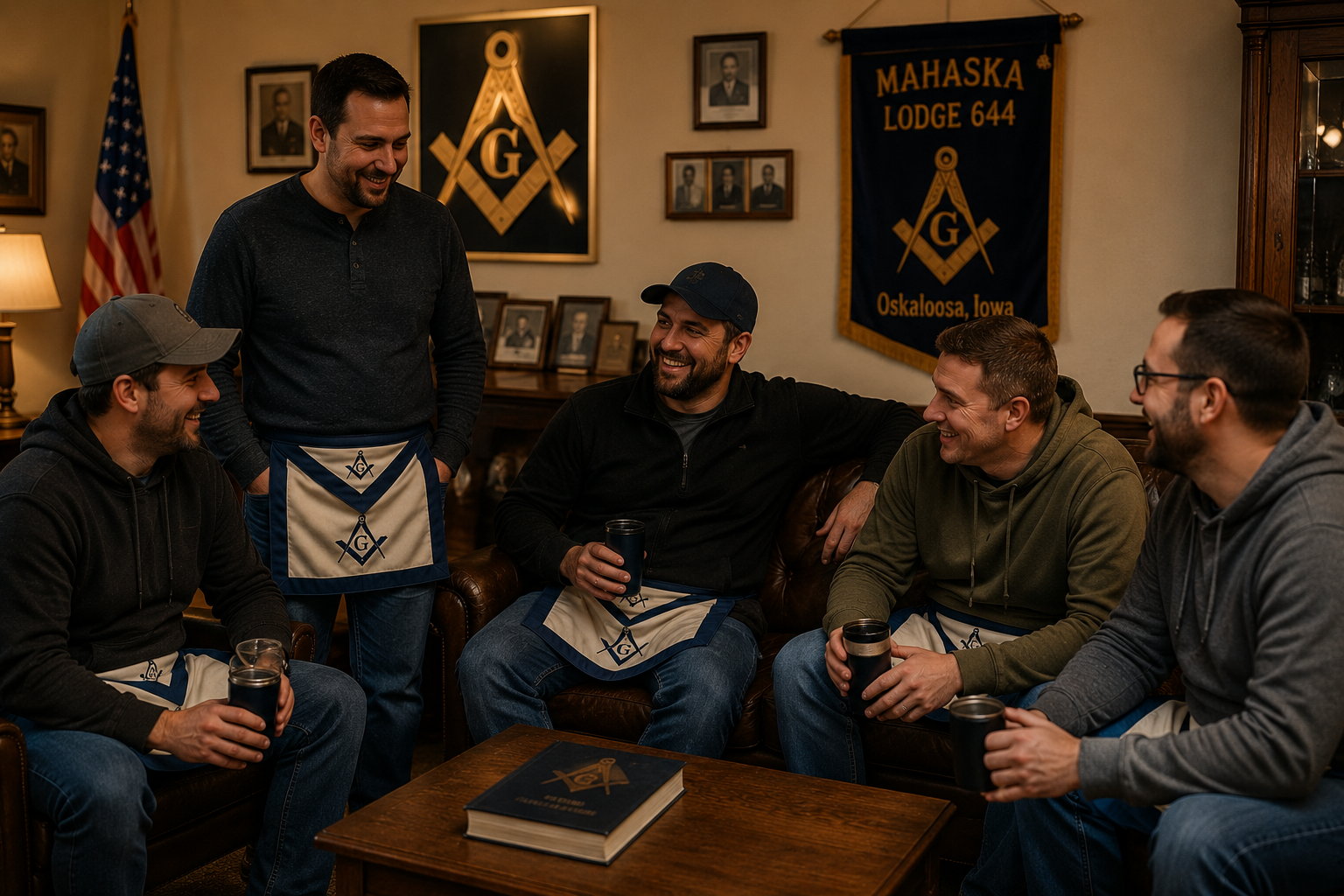
The first step to becoming a Freemason is simply reaching out and learning more. Anyone interested can visit Be A Freemason or contact Mahaska Lodge 644 directly. When you reach out, you can expect a welcoming conversation where members answer questions, explain what Freemasonry is about, and help you learn more about the brotherhood, personal growth, and values that Masonry stands for.
Create Your Own Website With Webador